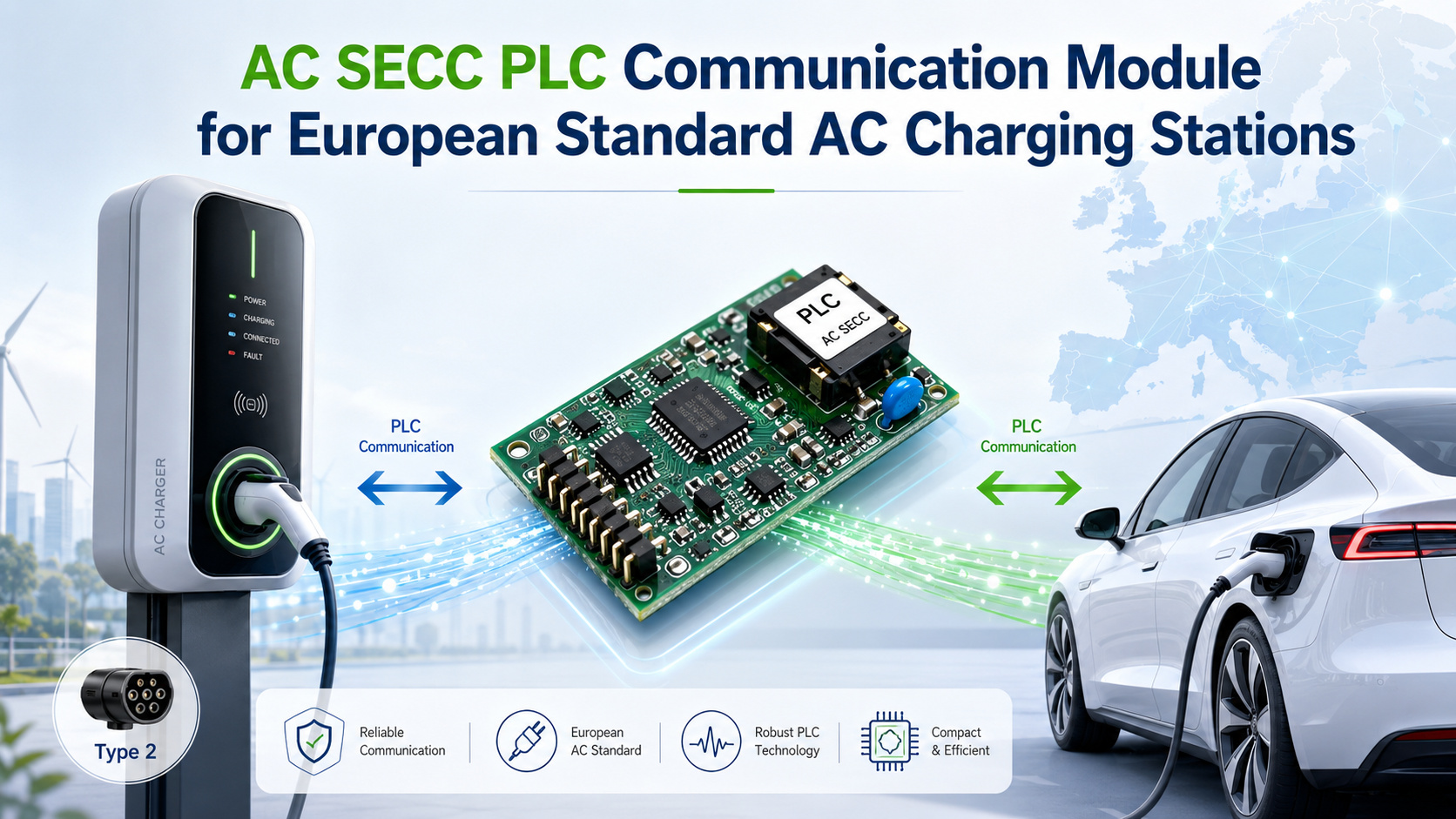
After adding an SECC, or Supply Equipment Communication Controller, communication module to a European standard AC charging station, such as one compliant with IEC 61851 and ISO 15118, the charger’s functionality and level of intelligence can be significantly improved. Its main roles include the following:
1. Supports Smart Charging Based on ISO 15118
Plug & Charge: Through mutual authentication between the vehicle and the charging station, based on PKI digital certificates, users do not need to swipe a card or scan a QR code. Once the connector is plugged in, identity verification and billing can be completed automatically, improving the user experience.
Automatic settlement: Secure communication between the vehicle and the charger can be linked directly to the user’s account, enabling seamless payment.
2. Supports Bidirectional Communication for V2G and V2H Readiness
Vehicle-to-grid: The SECC module enables the charging station to negotiate charging and discharging strategies with the electric vehicle. In the future, this can support reverse power delivery from EVs to the grid and help with grid peak shaving.
Energy management: The charger can coordinate with home or grid systems to optimize charging time, such as charging during off-peak electricity pricing, or to regulate charging power.
3. Advanced Load Management
Dynamic power allocation: In multi-connector charging stations or charging sites, the SECC can adjust the power distribution of each charger in real time to help avoid grid overload.
Priority control: Specific vehicle charging requests can be prioritized according to user needs or grid instructions.
4. Enhanced Safety and Compliance
Secure authentication: The module supports TLS-encrypted communication in ISO 15118, helping prevent data tampering or theft, including user privacy and billing information.
Standards compatibility: It complies with European standards such as DIN 70121 and ISO 15118, as well as future regulatory requirements, helping avoid technology obsolescence.
5. Remote Monitoring and Diagnostics
Real-time data reporting: The SECC module can upload charging status, fault information, and other data to a cloud management platform for easier operation and maintenance.
OTA upgrades: Charging station software can be updated remotely to support new functions or fix vulnerabilities.
6. Expanded User and Grid Services
Personalized services: Charging plans can be recommended based on user history, such as the lowest-cost charging time period.
Grid interaction: The charger can respond to grid demand, such as reducing charging power to balance load, and participate in demand-side management.
Typical Application Scenarios
Public charging stations: Supports unattended operation and automatic billing.
Home and commercial scenarios: Works with photovoltaic systems and energy storage equipment to optimize energy use.
Fleet management: Improves charging efficiency through centralized scheduling.
By adding an SECC module, a European standard charging station can be upgraded from a simple energy transfer device into an interactive node in the smart grid, laying the foundation for future electric mobility and energy interconnection.
Share Charging’s SECC is already a mature product in the market. Publicly available data shows that its installed volume has exceeded 30,000 units, demonstrating that the product has been widely validated by real market applications.