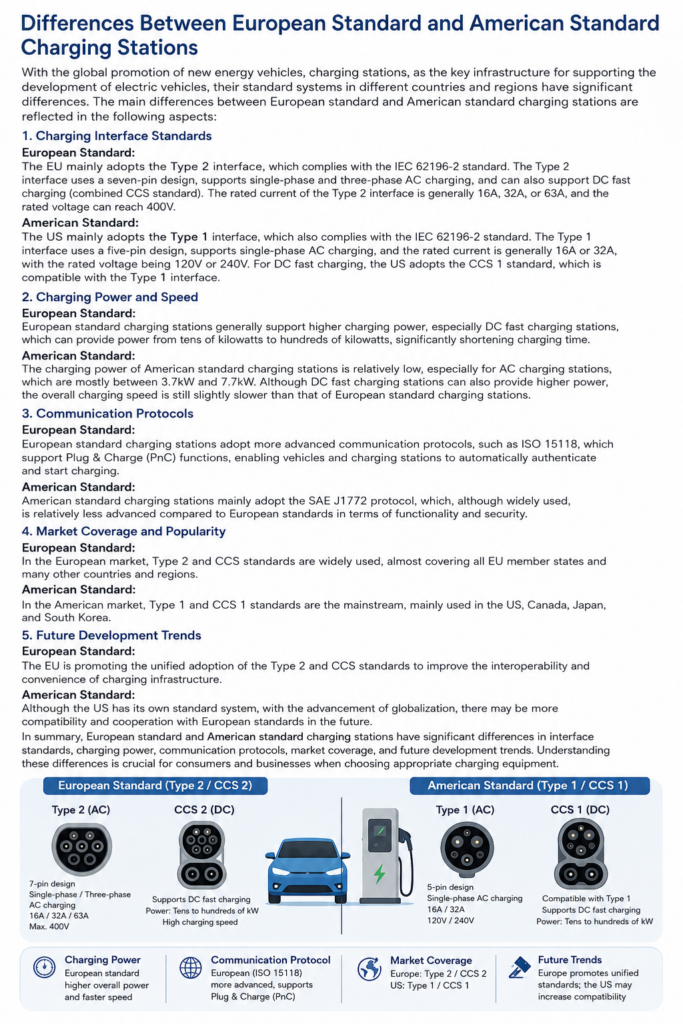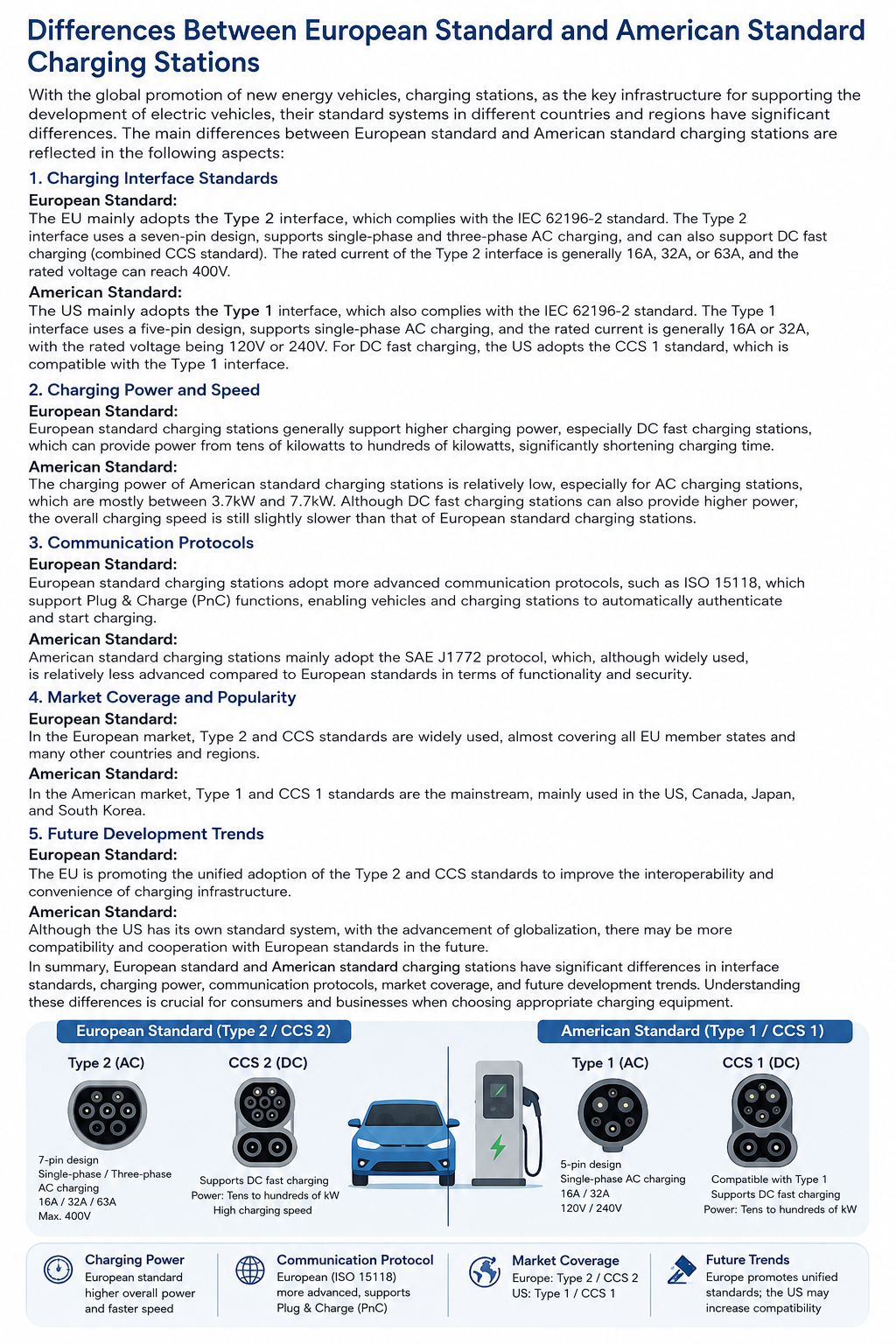
European-standard and American-standard DC EV charging solutions have significant differences in technical standards, connector protocols, grid adaptation, and market applications. They need to meet the regulations and user requirements of Europe and North America respectively.
1. Comparison Between European Standard and American Standard
| Item | European Standard, CCS2 | American Standard, CCS1 / Tesla NACS |
|---|---|---|
| DC connector standard | IEC 62196-3, CCS2 / Combo 2 | SAE J1772 CCS1 / Combo 1, or Tesla NACS |
| Communication protocol | ISO 15118, PLC; IEC 61851-23 | ISO 15118, PLC; SAE J1772 |
| Grid voltage | Three-phase AC 400V, 50Hz | Single-phase / three-phase AC 480V, 60Hz |
| Safety certification | CE, TÜV, RoHS | UL 2202, UL 2594, FCC / EMC |
| Metering regulation | MID certification, Class B accuracy | ANSI C12.20, U.S. metering standard |
2. Hardware Design Differences
2.1 Electrical Architecture
European Standard:
The input is three-phase 400V AC, which is rectified and converted into 200–1000V DC output, making it suitable for 800V high-voltage platforms. The typical topology is Vienna rectifier + LLC resonant DC/DC, with efficiency above 96%. For cooling, liquid-cooled charging cables can be used for 500A applications, while air cooling is commonly used for systems below 150kW.
American Standard:
The input can be three-phase 480V AC or single-phase 240V AC for residential fast-charging applications. The typical topology is PFC rectifier + dual active bridge, or DAB, supporting a wider voltage range of 150–500V. Tesla V3 Superchargers use liquid cooling for 250kW+ charging, while many CCS1 solutions use air cooling.
2.2 Charging Connector and Interface
| Feature | European CCS2 | American CCS1 / NACS |
|---|---|---|
| Physical interface | Combined connector, Type 2 AC + 2 DC pins | Combined connector, Type 1 AC + 2 DC pins, or Tesla-specific connector |
| Maximum current | 500A with liquid cooling | 400A for CCS1, 500A+ for liquid-cooled NACS |
| Locking mechanism | Mechanical lock + electronic lock, EN 62196 | SAE J1772 locking standard |
3. Software and Communication Protocols
3.1 Charging Control
European Standard:
European-standard charging commonly uses PLC communication. ISO 15118-20 supports V2G and Plug & Charge. For backend operation, OCPP 1.6 / 2.0 is commonly required by European charging operators.
American Standard:
Tesla NACS uses a dedicated communication approach based on CAN bus and proprietary protocols, rather than ISO 15118. For third-party compatibility, CCS1 solutions need to support SAE J3400 during the transition toward NACS standardization.
Summary
In general, European-standard and American-standard EV chargers differ mainly in connector type, communication protocol, grid input requirements, safety certification, metering standards, cooling design, and backend platform requirements. For manufacturers and project operators, selecting the correct charging standard is essential for product certification, vehicle compatibility, and successful market deployment.