Driven by carbon neutrality goals, China’s electric vehicle industry and EV charging infrastructure are moving toward overseas markets.
From a technical perspective, the charging communication of exported new energy vehicles needs to be converted from the CAN communication used in the GB/T standard to the intelligent PLC communication standard used in CCS systems.
This article explains the working mechanism of the European standard EVCC charging module based on the ISO 15118 communication protocol.
1. What Is EVCC?
EVCC stands for Electric Vehicle Communication Controller.
EVCC is an important charging communication component in the CCS electric vehicle charging process.
As the communication bridge between a CCS electric vehicle and a charging station, its main function is to convert the CAN communication protocol used by GB/T electric vehicles into the PLC communication method required by CCS EV charging standards.
Through this conversion, EVCC enables communication, power transfer control, and data exchange between electric vehicles and CCS charging systems.
In simple terms, EVCC allows GB/T electric vehicles to charge on overseas charging stations.
2. Main Functions of EVCC
EVCC can monitor the battery capacity of a CCS electric vehicle, control charging power and charging time, and record charging data for later analysis and management.
Through communication with charging equipment, EVCC can also provide users with information such as vehicle battery status and charging progress.
Overall, EVCC is an important controller in the electric vehicle charging process, helping ensure charging safety and high charging efficiency.
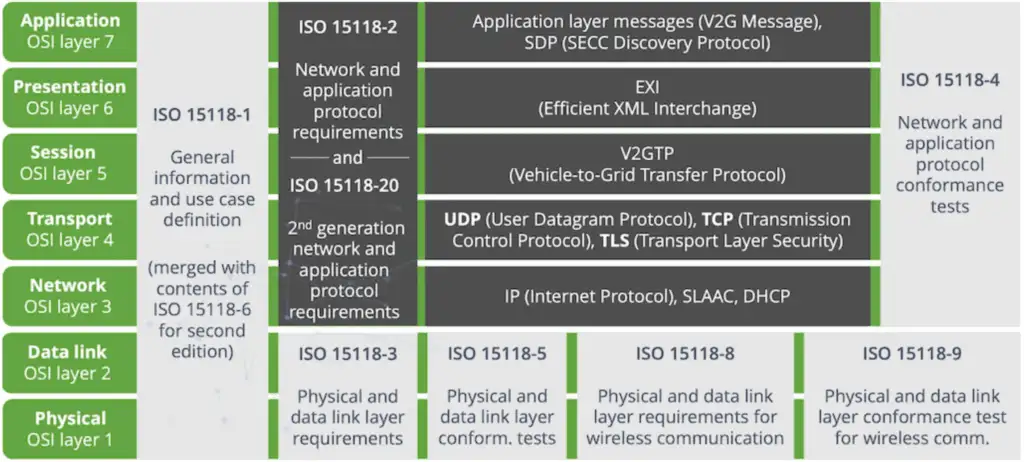
[Image: ISO 15118 communication layers and EVCC / SECC charging communication architecture]
3. ISO 15118 Communication Architecture
When a CCS electric vehicle is connected to a CCS charging connector, the vehicle-side communication controller EVCC and the charging station-side communication controller SECC establish a communication network.
SECC stands for Supply Equipment Communication Controller.
The purpose of this communication network is to exchange messages and start the charging session.
Both EVCC and SECC must support the seven functional layers required to process transmitted and received information.
Each layer is built on the functions provided by the lower layer, starting from the application layer at the top and extending down to the physical layer.
For example, the physical layer and data link layer define how the EV and EVSE use the charging cable as the physical communication medium.
In ISO 15118-3, this is achieved through power line communication using a HomePlug Green PHY modem.
In wireless communication scenarios, ISO 15118-8 refers to Wi-Fi communication based on IEEE 802.11n.
After the data link is correctly established, the network layer and transport layer can rely on it to establish a TCP/IP connection.
This allows messages to be routed correctly from the EVCC to the SECC and back.
At the top, the application layer uses the established communication path to exchange messages related to specific use cases, such as AC charging, DC charging, or wireless charging.
4. Current Market Challenges
Inconsistent Communication Standards
Domestic and overseas charging communication standards are not unified.
As a result, domestic charging strategies cannot directly meet overseas charging function requirements.
Compatibility Issues
Non-standard protocols may cause compatibility problems between new vehicles and charging stations.
This makes it difficult for some vehicles and charging equipment to communicate with each other properly.
Energy Waste
Without intelligent scheduling, renewable energy utilization may be affected, resulting in unnecessary energy loss.
5. Technical Highlights of Nanjing Share Charging EVCC
CAN-to-PLC Dual-Mode Communication
Nanjing Share Charging’s PLC EVCC protocol converter enables CAN-to-PLC communication conversion.
This helps GB/T vehicles adapt to CCS charging systems used in overseas markets.
Smart V2G Algorithm Engine
The Smart V2G algorithm engine dynamically optimizes charging and discharging strategies.
This helps improve the utilization rate of green electricity.
DIN 70121 and ISO 15118 Compatibility
The EVCC solution supports DIN 70121 and ISO 15118 communication standards.
It can support charging communication requirements for European standard CCS charging systems.
Plug & Charge Security Authentication
The solution supports Plug & Charge security authentication, helping simplify the charging process and improve user experience.
Multi-Standard Compatibility
The solution is compatible with multiple charging standards, including CCS, CHAdeMO, and GB/T.
6. Application Value
Through the physical layer design of the EVCC module and optimization of the ISO 15118 application layer protocol, this solution helps support the overseas application of charging communication systems.
In 50kW DC fast charging scenarios, the solution can help optimize system performance and provide key technical support for Chinese new energy vehicles entering overseas markets.
Summary
The EVCC-PLC communication charging system is a key solution for Chinese new energy vehicles entering European and international charging markets.
By converting GB/T CAN communication into CCS PLC communication based on ISO 15118, the EVCC module enables charging compatibility, data exchange, power transfer control, and intelligent charging functions.
For export vehicle projects, this solution can help reduce adaptation difficulty, improve charging compatibility, and support global deployment.
The above content is from Share Charging.