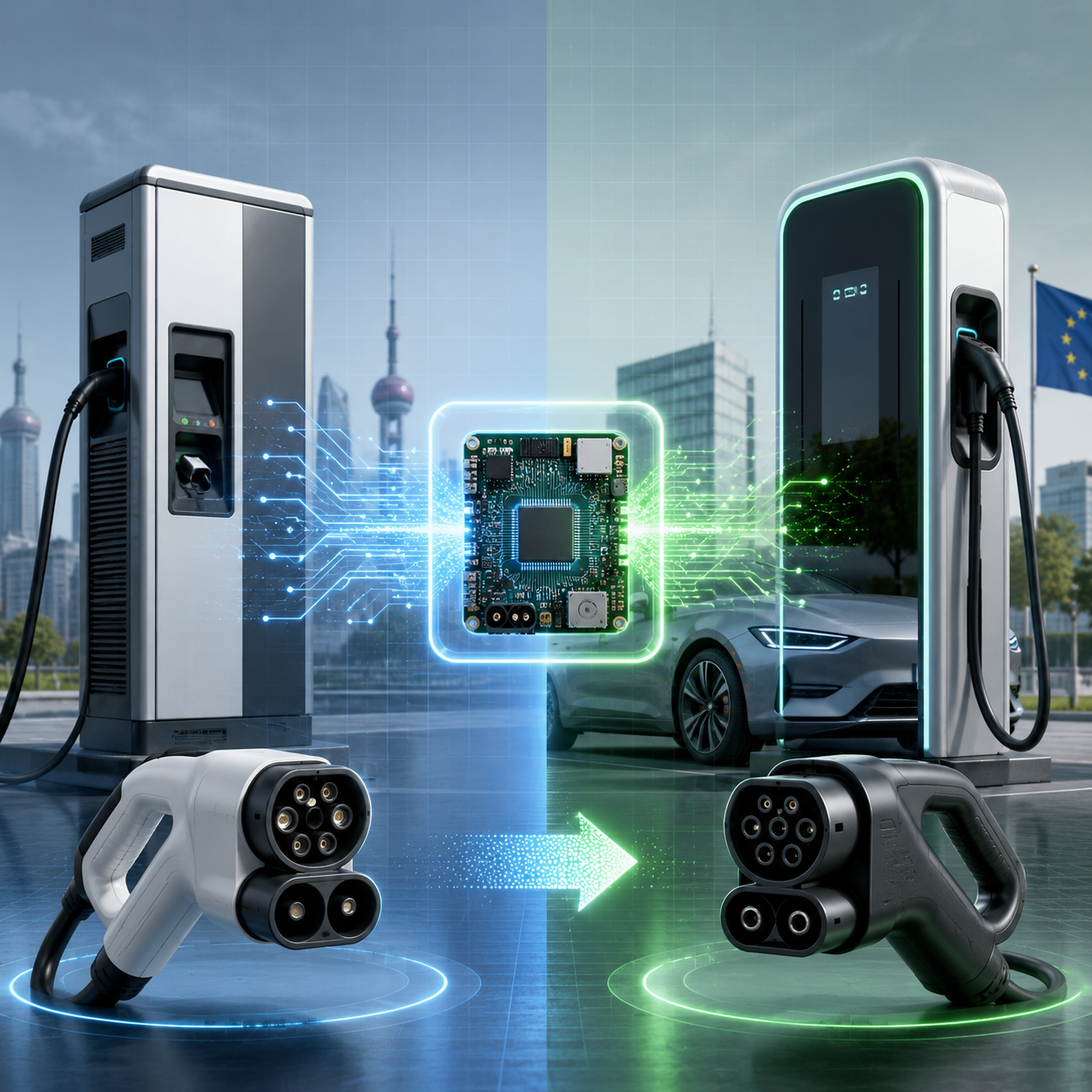
Converting a Chinese domestic DC charging station, usually based on GB/T standards, into a DC charging station that complies with European or U.S. standards requires a comprehensive upgrade of hardware, software, communication protocols, and certification requirements.
The following are the key steps and considerations.
1. Confirm the Target Charging Standard
Before starting the conversion, it is necessary to confirm the target market and charging standard.
CCS Combo 2
CCS Combo 2 is the mainstream DC fast charging standard in Europe. It combines the Type 2 AC charging interface with DC fast charging pins.
A CCS Combo 2 charging station needs to support ISO 15118 for PLC communication and DIN 70121 for DC charging control.
CHAdeMO
CHAdeMO is mainly used in Japan and some vehicle models in Europe. It requires support for CAN bus communication protocols, such as ISO 11898.
Other Technical Requirements
The conversion also needs to consider voltage range, cooling method, and power level.
For example, European standard DC charging stations may support higher voltage platforms, such as up to 920V, and high-power chargers may require liquid cooling or upgraded cable specifications.
2. Hardware Conversion
Charging Connector Replacement
The GB/T charging connector needs to be replaced with a charging connector that matches the target standard, such as a CCS Combo 2 charging connector.
Cable and Cooling System Upgrade
European and U.S. markets may require higher charging power, such as 350kW fast charging.
In this case, the cable cross-section may need to be upgraded, or a liquid-cooled charging cable may be required.
3. Internal Electrical Adjustment
Voltage and Current Adaptation
The output range of the charging modules needs to be adjusted according to the requirements of overseas vehicle models.
For example, the system may need to support a wider voltage range, such as 200V to 1000V.
Safety Protection Upgrade
The insulation monitoring circuit, ground fault protection, and other safety protection circuits should be updated to comply with international standards such as IEC 61851-23.
Communication Module Upgrade
For CCS charging, a PLC communication module is required.
The charging station needs to support ISO 15118 communication based on HomePlug GreenPHY. Share Charging’s SECC can be used for this communication adaptation and can support both European and U.S. standard charging protocols.
For CHAdeMO or other CAN-based applications, the CAN bus communication protocol also needs to be adapted.
4. Software and Protocol Adaptation
Communication Protocol Adaptation
Share Charging’s SECC can be used to adapt the charging communication protocol. It supports European and U.S. standard charging communication requirements.
For CCS charging, the system needs to support ISO 15118 and DIN 70121.
For CHAdeMO, the charging station should support CHAdeMO 2.0 or higher versions.
Charging Control Logic
The charging control logic needs to be adjusted, including handshake, authentication, charging start, charging stop, and abnormal shutdown processes.
User Interface and Payment System
The charging station interface should be localized according to the target market.
This may include language changes, local payment methods, RFID card support, and pricing currency such as EUR or USD.
5. Certification and Compliance
CE Certification
For the European market, CE certification is usually required.
The certification may include EMC requirements, safety requirements, and charging system-related standards such as EN 61851-21 and EN 62196-3.
Local Regulations
Different countries may have additional requirements.
For example, Germany may require TÜV-related certification, while France may have NF standard requirements.
Interoperability Testing
The converted charging station should complete interoperability testing with mainstream vehicles and charging platforms.
For CCS charging systems, compatibility testing with CharIN-related requirements may be necessary.
Share Charging can also provide EVCC and SECC-related testing support for charging communication compatibility.
Summary
To convert a GB/T DC charging station into a European or U.S. standard charging station, it is not enough to simply replace the charging connector.
A complete conversion usually includes:
charging connector replacement, cable and cooling upgrade, voltage and current adaptation, safety protection upgrade, PLC communication module integration, SECC protocol adaptation, software logic adjustment, user interface localization, payment system adaptation, and certification testing.
For export charging station projects, using a mature SECC communication solution can greatly reduce development difficulty, shorten the adaptation cycle, and improve compatibility with overseas electric vehicles and charging standards.