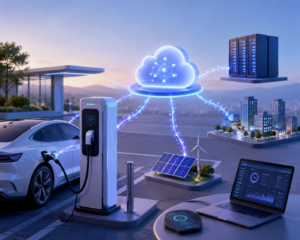
As electric vehicles continue to develop from simple charging devices into distributed energy storage units, the integration of OCPP and ISO 15118 is becoming increasingly important for smart charging infrastructure.
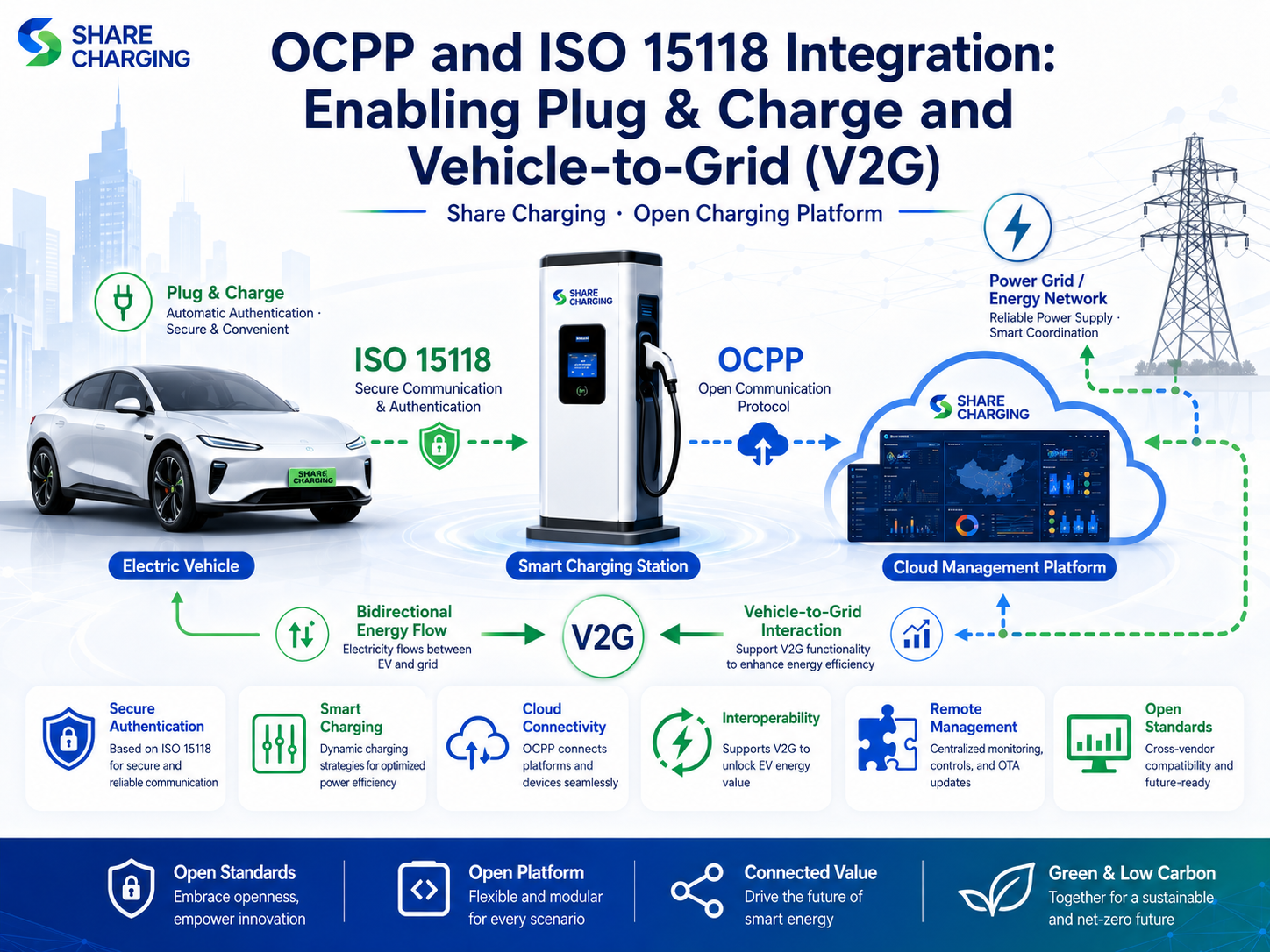
OCPP is mainly responsible for communication between the charging station and the central management system, while ISO 15118 focuses on communication between the electric vehicle and the EVSE.
When these two protocols work together, charging networks can support advanced functions such as Plug & Charge, secure authentication, smart charging, and Vehicle-to-Grid, also known as V2G.
[Image: OCPP and ISO 15118 integration architecture]
1. Interaction Between ISO 15118 and OCPP
ISO 15118 defines the communication between the electric vehicle and the charging equipment.
This communication can be implemented through PLC, such as HomePlug Green PHY, or through wireless communication methods.
OCPP defines the communication between the charging station and the CSMS, or Charging Station Management System.
The key to integrating the two protocols is data forwarding and event triggering.
In a typical architecture, the vehicle communicates with the EVSE through ISO 15118, while the EVSE communicates with the CSMS through OCPP.
The basic architecture can be understood as:
EV → ISO 15118 → EVSE → OCPP → CSMS
At the application layer, OCPP can use messages such as DataTransfer to carry ISO 15118-related data.
At the control level, when the charging station detects that a vehicle has been connected, it can trigger OCPP transaction events and forward key ISO 15118 session information to the CSMS.
2. Plug & Charge Implementation
Plug & Charge is one of the most important functions enabled by ISO 15118.
It allows the vehicle to complete authentication and charging authorization automatically after being connected to the charging station.
The implementation usually includes the following steps.
First, the vehicle and the charging system need to have the required certificate infrastructure.
The vehicle may carry a contract certificate, while the charging station and backend system need to verify the certificate chain.
Second, the vehicle sends certificate-related information to the charging station.
The charging station then works with the CSMS to verify whether the certificate is valid.
Third, after authentication is completed, the CSMS confirms the user authorization and associates the charging session with the billing account.
Finally, the charging process can start automatically without requiring the user to scan a QR code, swipe a card, or manually operate an app.
// OCPP DataTransfer消息封装ISO 15118数据
{
“vendorId”: “ISO15118-2”,
“messageId”: “SessionSetupReq”,
“data”: “EXI::H4sIAAAAAAAEAJYtq9T…(Base64编码的EXI数据)”
}
3. V2G Energy Scheduling and OCPP Power Control
To support Vehicle-to-Grid applications, OCPP smart charging functions need to work together with ISO 15118 vehicle-side communication.
In a V2G scenario, the CSMS may receive demand response signals from the grid operator.
Based on these signals, the CSMS generates a charging or discharging strategy.
The charging station can then receive power control instructions through OCPP, such as charging power limits or reverse power commands.
At the same time, the vehicle and EVSE negotiate charging or discharging parameters through ISO 15118.
During the process, the charging station continuously reports metering data to the CSMS, including imported power and exported power.
This allows the backend platform to monitor the charging and discharging process in real time.
4. Dual-Layer Security Design
The integration of OCPP and ISO 15118 requires strong security protection at both the transport layer and the application layer.
At the transport layer, OCPP usually uses TLS encryption to protect the WebSocket connection between the charging station and the CSMS.
ISO 15118 also uses TLS-based secure communication to protect the communication between the electric vehicle and the charging station.
At the application layer, OCPP can use message signatures to prevent tampering.
ISO 15118 relies on digital certificates and mutual authentication to verify the identities of the vehicle and the charging equipment.
This dual-layer security design helps protect charging data, user identity, payment authorization, and vehicle-grid interaction.
车辆证书 → 合同CA → 子CA → MO根CA
充电桩证书 → 制造商CA → MO根CA
5. Debugging and Troubleshooting
During system integration, engineers need to connect OCPP transaction data with ISO 15118 session data.
For example, the OCPP transaction ID and the ISO 15118 session ID can be associated in the backend system.
This makes cross-protocol log tracing easier.
Error code mapping is also important.
For example, a vehicle-side or ISO 15118 communication error can be mapped to an OCPP fault or diagnostic event, helping the platform identify and report the issue.
Simulation tools can also be used for joint debugging.
Engineers can combine OCPP simulators with ISO 15118 test tools to verify certificate expiration, signature errors, communication failures, and other abnormal scenarios.
6. Performance Optimization and Challenges
OCPP and ISO 15118 integration still faces several technical challenges.
V2G applications require low-latency response to grid commands.
The CSMS and charging station must process messages efficiently to ensure that control instructions can be delivered quickly.
For low-cost charging equipment, EXI encoding and decoding may create performance pressure.
In this case, lightweight protocol libraries and optimized software architecture are important.
Interoperability testing is also essential.
Because different vehicles, charging stations, and backend platforms may implement protocols differently, joint testing is required to verify compatibility across multiple manufacturers.
Summary
The integration of OCPP and ISO 15118 is an important technical foundation for next-generation smart charging systems.
ISO 15118 enables secure vehicle-to-charger communication, Plug & Charge, and V2G interaction.
OCPP connects charging stations with the central management system and supports remote control, smart charging, billing, monitoring, and energy scheduling.
Together, these two protocols help charging infrastructure evolve from simple charging equipment into intelligent energy network nodes.