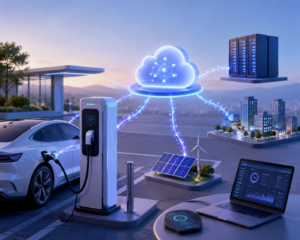
Looking at the global market, the development of electric vehicles is closely related to the development of charging infrastructure.
Many countries have realized that charging stations are a key infrastructure factor that will affect the future of electric vehicles.
As a result, different countries have introduced their own policies to support the construction and application of EV charging infrastructure.
Below are several examples of charging infrastructure policies in European countries.
1. Germany: Charging Infrastructure Is a Key Weakness in EV Development
In 2019, the German government released the Master Plan for Charging Infrastructure.
The plan proposed building one million public charging stations by 2030.
As of 2020, Germany had about 40,000 charging stations.
To reach the 2030 target, Germany would need to install around 8,000 charging stations every month.
However, the current installation speed of new charging stations in Germany is about 1,000 units per month, according to VDA data.
This means that achieving the 2030 target remains a challenging task.
1.1 German Charging Infrastructure Subsidies Are Linked to Power Levels
Germany provides different levels of subsidies for public charging stations based on power and voltage.
The requirements are detailed and relatively specific, similar to the logic of local charging infrastructure subsidies in China.
For private charging stations, homeowners, tenants, and residential community developers can apply for subsidies of up to 900 euros for charging infrastructure construction.
2. United Kingdom: Moderate Targets and a Relatively High Vehicle-to-Charger Ratio
On March 25, 2022, the UK government released its Electric Vehicle Infrastructure Strategy.
The strategy proposed investing at least 1.6 billion pounds to significantly expand the UK EV charging network.
The goal is to support the 2030 target of banning the sale of new gasoline and diesel vehicles.
By 2030, the UK aims to increase the number of EV charging stations tenfold to 300,000.
By 2035, the UK plans to install more than 600 ultra-fast charging stations on highways in England.
As of January 2022, the UK had 28,375 public charging infrastructure points, including 5,156 fast chargers.
The vehicle-to-charger ratio in the UK was around 13:1, which is relatively high.
2.1 UK Charging Infrastructure Subsidies Are Based on Application Scenarios
For charging infrastructure subsidies, the UK promotes charging network construction through subsidies, tax incentives, and regional incentives.
The subsidies are divided by application scenarios, such as home charging, workplace charging, and residential community charging.
The maximum subsidy for home and workplace charging is 350 pounds.
For on-street residential charging infrastructure, the subsidy standard can reach 6,500 pounds.
Companies installing charging infrastructure may also receive 100% tax relief.
3. Netherlands: Strong Charging Infrastructure Development with a Focus on Smart Charging
Globally, apart from China and the United States, the Netherlands has one of the largest numbers of charging infrastructure installations.
Its charging infrastructure volume is roughly twice that of Germany during the same period.
Among European countries, the Netherlands also ranks highly in charging station density.
Its vehicle-to-charger ratio is about 4:1.
The Netherlands places strong emphasis on smart charging.
It has stated that by 2025, smart charging stations could serve around 70% of electric vehicles.
By the end of April 2022, the number of public charging stations in the Netherlands had increased to 100,000, including 3,250 fast charging stations.
3.1 The Netherlands Focuses on Public Charging Station Subsidies
The Netherlands’ planning and subsidy policies mainly target public charging station construction.
There are currently two main approaches: environmental investment tax exemption and random depreciation for environmental investment.
Although there are no subsidies for private charging stations, residents can apply at any time for the free installation of public charging stations to meet their charging needs.
The above content is from Share Charging.