[Image: SECC protocol conversion and CCS charging communication diagram]
Share Charging’s SECC charging-station-side communication protocol conversion technology provides a systematic solution for Chinese charging station brands to access global CCS DC charging networks.
Its key technical features and application logic are as follows.
Core Mechanism of Protocol Conversion
Bidirectional Protocol Adaptation
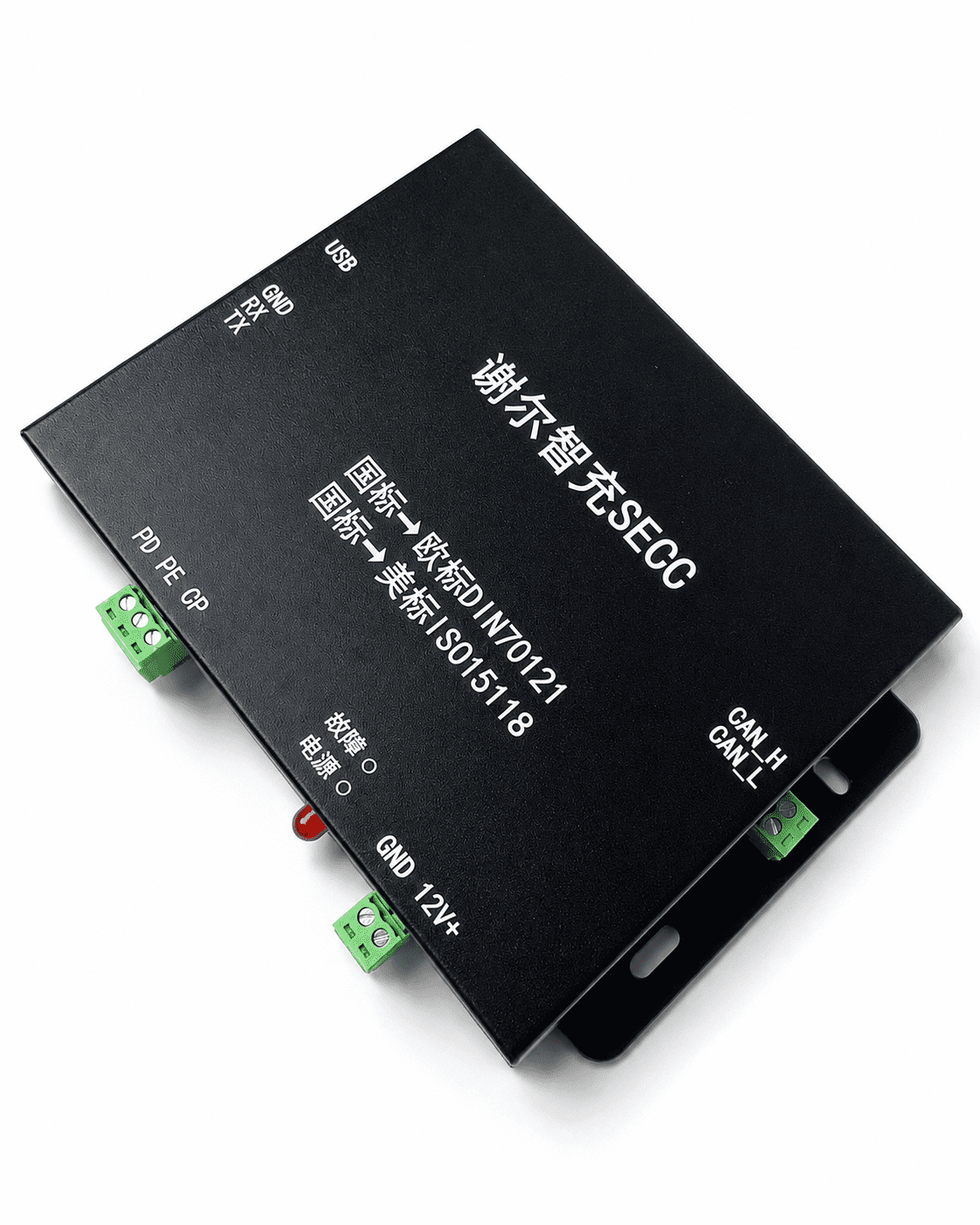
The SECC module works as a hardware middleware embedded inside a GB/T charging station.
It enables bidirectional communication through the following path.
On the input side, it receives GB/T 27930 protocol signals from the Chinese standard charging station.
On the output side, it converts these signals in real time into CCS communication protocols used in target regions, including European CCS2 and North American CCS1.
The system is compatible with international standards such as ISO 15118 and DIN 70121.
Underlying Communication Reconstruction
The solution converts GB/T CAN bus communication into PLC, or Power Line Communication.
This meets the physical-layer interaction requirements of CCS charging systems and helps ensure stable signal transmission.
Global Adaptation Capability
Full-Brand Compatibility
The solution supports DC charging stations from any Chinese brand that complies with the GB/T standard, including integrated AC and DC charging stations.
Through modular transformation, it enables the conversion from a GB/T charging station to a CCS charging station.
Multi-Region Coverage
For the European market, the solution adapts to CCS2 connectors and meets the EU charging infrastructure requirements for intelligent communication.
For the North American market, it supports the CCS1 protocol and SAE J1772 standard, making it suitable for charging requirements in local grid environments.
For Japanese and Korean markets, the solution can be extended to support the CHAdeMO protocol, covering more diversified export scenarios.
Implementation Path and Application Cases
Hardware Transformation Process
The implementation process usually includes three steps.
First, the SECC protocol converter is installed inside the GB/T charging station.
Second, the GB/T charging connector is replaced with a CCS-compatible charging connector, such as a Type 2 connector with extended DC pins.
Third, the charging station control program is upgraded to activate the protocol conversion function.
Commercial Verification
The solution has been applied to 20kW to 40kW low-power DC charging station export projects.
It is suitable for distributed charging scenarios in Europe, such as supermarkets, communities, and commercial locations.
The solution has passed TÜV and DEKRA certification requirements in the European Union, meeting CCS charging station safety and communication compliance requirements.
Technical Value and Market Significance
Lower Export Cost
The solution avoids complete charging station redesign.
By using modular transformation, Chinese charging stations can connect to mainstream global charging networks.
Improved Compatibility Efficiency
It solves the communication barrier between GB/T charging stations and CCS vehicles.
It can also support Plug & Charge functions.
Response to Policy Demand
The solution aligns with the deployment direction of medium- and low-power charging stations under the EU plan for one million charging stations by 2030.
Note
Through real-time protocol translation at the protocol layer and standardized hardware interfaces, this solution helps connect Chinese charging infrastructure technology with international markets more seamlessly.
The above content is from Share Charging.