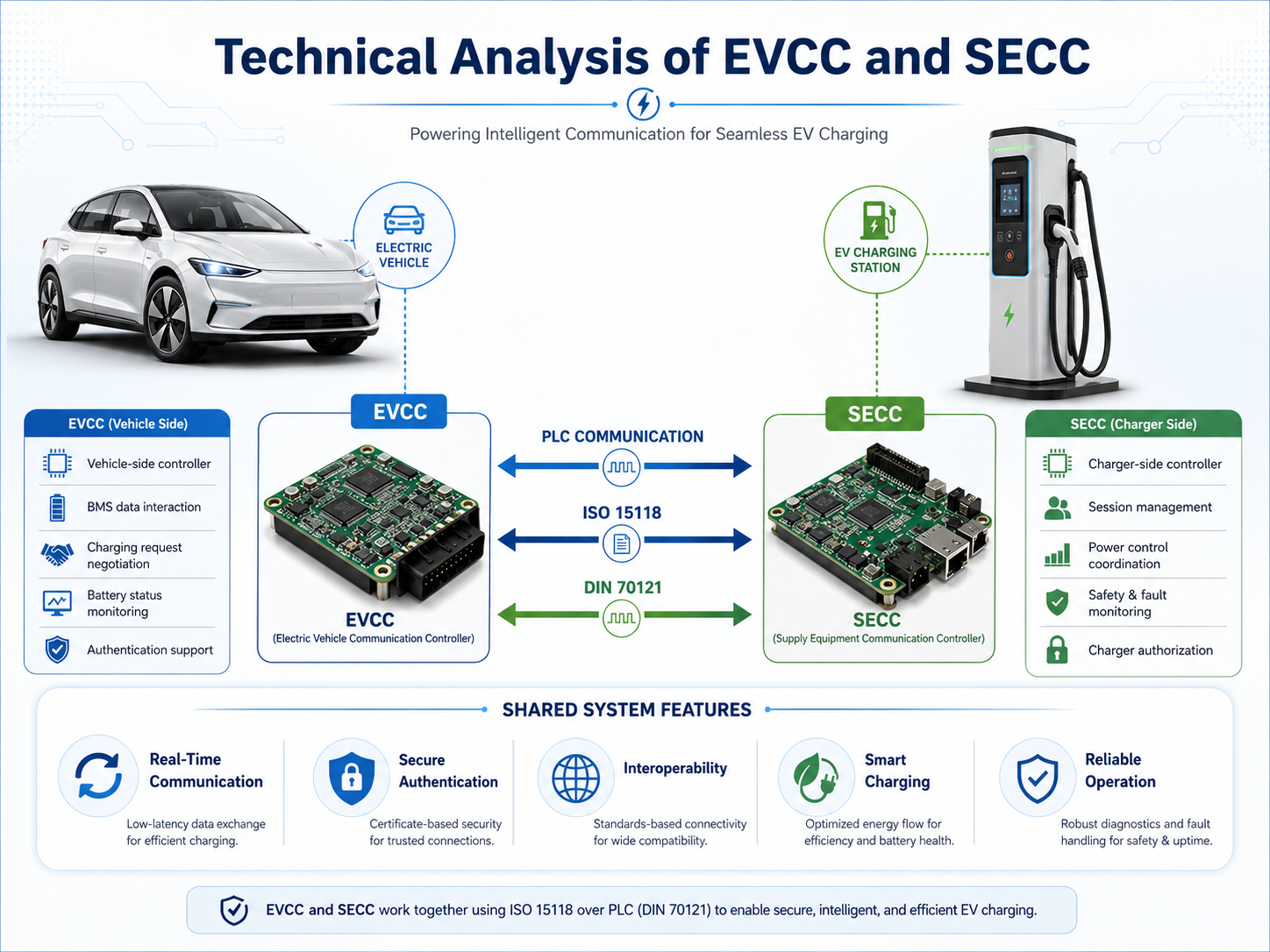
EVCC and SECC are two key communication controllers in electric vehicle charging systems.
EVCC is installed on the electric vehicle side, while SECC is installed on the charging station side.
Together, they build the communication link between the electric vehicle and the charging station, enabling charging control, parameter negotiation, safety monitoring, and advanced charging functions.
[Image: EVCC and SECC communication architecture in an EV charging system]
1. Core Component Functions
EVCC
EVCC stands for Electric Vehicle Communication Controller.
It acts as the communication controller of the electric vehicle and serves as the interaction hub between the electric vehicle and the charging station.
One of the main functions of EVCC is to convert Chinese GB/T CAN signals into PLC communication signals used in European and North American CCS charging systems.
EVCC integrates key functions such as charging process control, current and voltage adjustment, charging mode control, pre-charge control, Plug & Charge, and V2G.
For Chinese electric vehicles exported to Europe, North America, and other overseas markets, EVCC is one of the key components for adapting the vehicle to local charging standards.
SECC
SECC stands for Supply Equipment Communication Controller.
It is the communication controller installed on the charging station side.
Through PLC technology, SECC establishes a bidirectional communication link with the vehicle-side EVCC.
It completes charging parameter negotiation, real-time monitoring, and safety strategy execution.
SECC can be integrated inside the charging station or deployed as an independent device.
2. Communication Protocol Architecture
The EVCC and SECC communication system is based on the client-server model defined by ISO 15118.
In this architecture, the EVCC initiates requests, and the SECC responds.
The system supports TLS encrypted communication channels and mutual authentication to ensure data security during the charging process.
3. Extended Functions
The EVCC and SECC system can support advanced charging functions.
Bidirectional Power Transfer
Bidirectional Power Transfer, or BPT, enables energy feedback between the electric vehicle and the grid.
This creates the technical foundation for V2G, V2H, and other vehicle-to-everything energy interaction scenarios.
Automatic Connection Device
Automatic Connection Device, or ACD, can help improve the user experience by enabling more automated charging connection processes.
4. Technical Development Trends
Stronger Interoperability
Through standardized testing specifications, such as CharIN CCS certification, EVCC and SECC products can achieve better compatibility across different vehicle brands and charging station brands.
Smart Grid Integration
EVCC and SECC systems are moving toward deeper integration with smart grids.
Future applications may include dynamic electricity price response, load balancing, and more advanced V2X scenarios.
Modular Design
New-generation controllers are increasingly adopting software and hardware decoupling architectures.
This makes OTA upgrades easier and helps products adapt to charging standard differences across different regions.
5. Application Recommendations
For EVCC development in export vehicle projects, the following points should be given special attention.
European PLC Frequency Compatibility
EVCC products for European charging applications should pay attention to PLC frequency compatibility, such as the 3 kHz to 500 kHz range.
ISO 15118-20 Support
ISO 15118-20 provides extended protocol support for functions such as Plug & Charge and advanced smart charging.
For future export projects, ISO 15118-20 compatibility may become increasingly important.
EMC Compliance
Electromagnetic compatibility, or EMC, should comply with standards such as the EN 61000-6 series.
This helps ensure stable operation of EVCC and SECC systems in real charging environments.
Summary
EVCC and SECC form the core communication system between electric vehicles and charging stations.
EVCC is responsible for vehicle-side communication and charging control, while SECC is responsible for charging station-side communication and protocol interaction.
Together, they support charging parameter negotiation, secure communication, protocol conversion, Plug & Charge, V2G, and future smart charging applications.
The above content is from Share Charging.