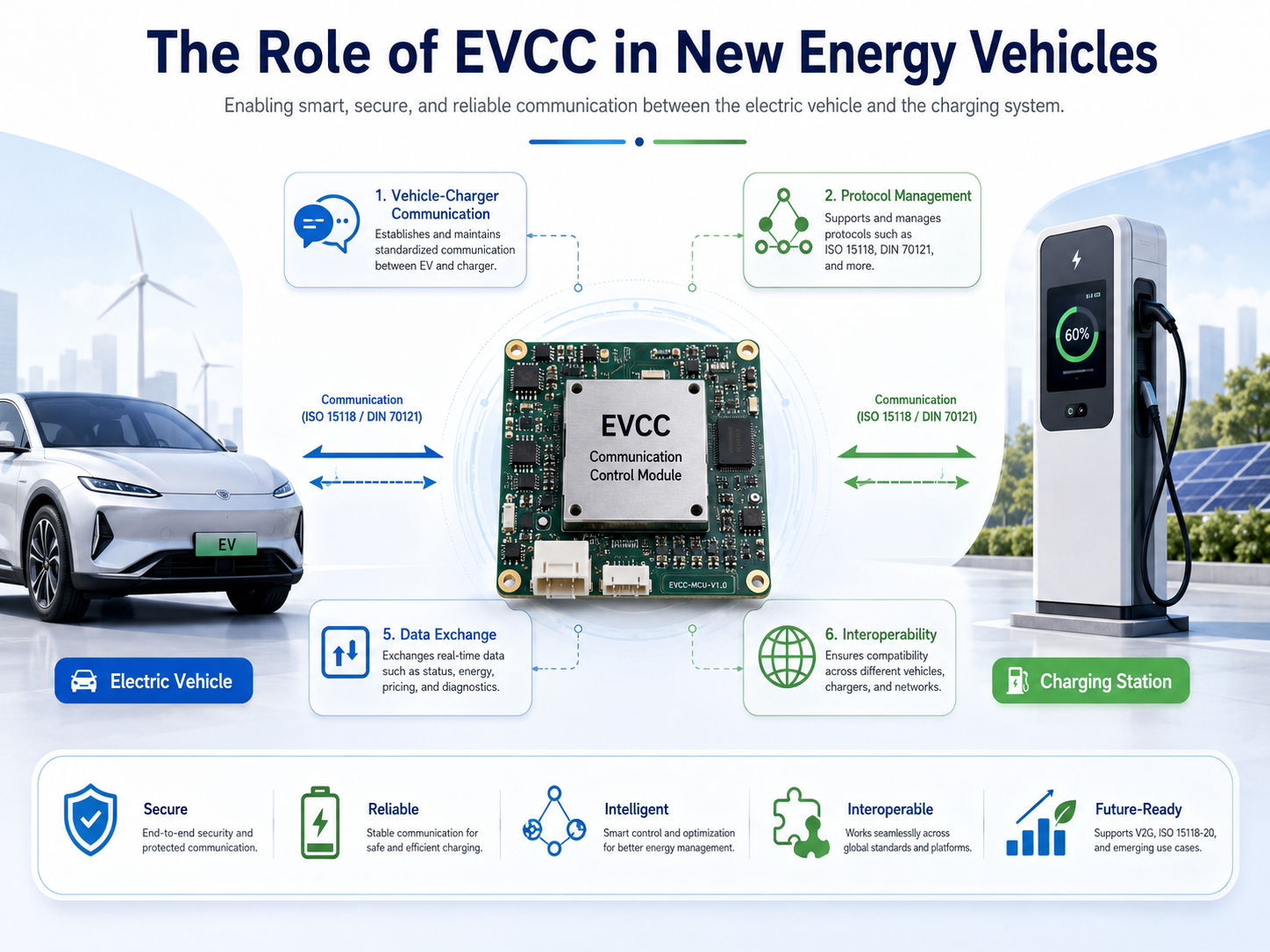
The Electric Vehicle Communication Controller, or EVCC, is a core component in the charging system of new energy vehicles. Its main function is to solve the compatibility problem between Chinese domestic electric vehicles and international charging standards, enabling seamless charging in global markets.
Below are its key functions and technical features.
Core Functions of EVCC
1. Charging Protocol Conversion
EVCC converts the GB/T 27930 CAN communication protocol used in Chinese standard vehicles into international charging communication protocols, such as ISO 15118, DIN 70121, SAE J1772, PLC-based communication, or Japan’s CHAdeMO protocol.
It supports bidirectional communication control and enables real-time data exchange between the vehicle and the charging station, including charging parameter negotiation, start commands, and stop commands.
2. Global Charging Compatibility
EVCC allows Chinese standard electric vehicles to connect with overseas charging stations, such as European CCS chargers and Japanese CHAdeMO chargers, without major hardware redesign.
This helps reduce the export adaptation cost for vehicle manufacturers.
It also supports localized charging socket replacement, such as replacing the charging inlet with European, American, or Japanese standard connectors, making the export process easier.
3. Safety and Intelligent Control
EVCC integrates protection mechanisms such as overcurrent protection, overvoltage protection, and temperature protection.
It monitors the charging status in real time to ensure safe and stable charging.
It also supports intelligent charging strategies, such as V2G, scheduled charging, and OTA remote upgrades.
Application Scenarios and Value
Key Component for Vehicle Export
EVCC is usually installed near the vehicle charging port. By matching the BMS software, it allows Chinese standard vehicles to charge on overseas charging infrastructure.
Multi-Protocol Compatibility
EVCC can adapt to mainstream vehicle models and charging station brands, helping vehicles work with different charging environments in overseas markets.
Lower Technical Development Cost
By using EVCC, vehicle manufacturers can avoid redesigning the entire vehicle charging system.
This helps shorten the development cycle from several years to only a few months in some export adaptation projects.
Technical Implementation
Hardware Design
EVCC adopts a modular circuit design and supports electronic lock detection, terminal resistor configuration, and short-circuit protection.
Software Protocol
The system includes built-in UDS diagnostic services and can support customized private protocols to meet the requirements of different regional regulations.
Safety Certification
EVCC supports ISO 15118-related TLS encryption and PnC, or Plug and Charge, protocol requirements.
It can also support TARA, or Threat Analysis and Risk Assessment, for automotive cybersecurity analysis.
Summary
EVCC combines protocol conversion, intelligent control, and safety protection into one technical solution.
It acts as a communication bridge for Chinese standard electric vehicles entering overseas markets and helps improve the global competitiveness of Chinese new energy vehicles.
Share Charging’s EVCC has been installed in more than 150,000 exported passenger vehicles.
(share-charging.cn)