Electric vehicles, or EVs, are reshaping the automotive industry in terms of both sustainability and technology. EVs not only reduce greenhouse gas emissions and dependence on fossil fuels, but also drive innovation in aerodynamics, lightweight materials, batteries, powertrains, inverters, software, advanced driver assistance systems, or ADAS, charging systems, cables, and more.
Progress has also been made in efficiency, driving range, and vehicle cost, encouraging more drivers to consider switching from traditional fuel-powered vehicles. Although this decision largely depends on battery life and driving range, another equally important innovation is the vehicle’s communication capability.
In fact, most EV functions, from driving to charging, depend on electronic communication protocols.
A variety of communication standards are used in electric vehicles and EV charging, including:
Most EVs rely on the Controller Area Network, or CAN, protocol to communicate between vehicle components and external systems.
Modbus and Local Interconnect Network, or LIN, protocols are used by some auxiliary vehicle components that do not require real-time data communication.
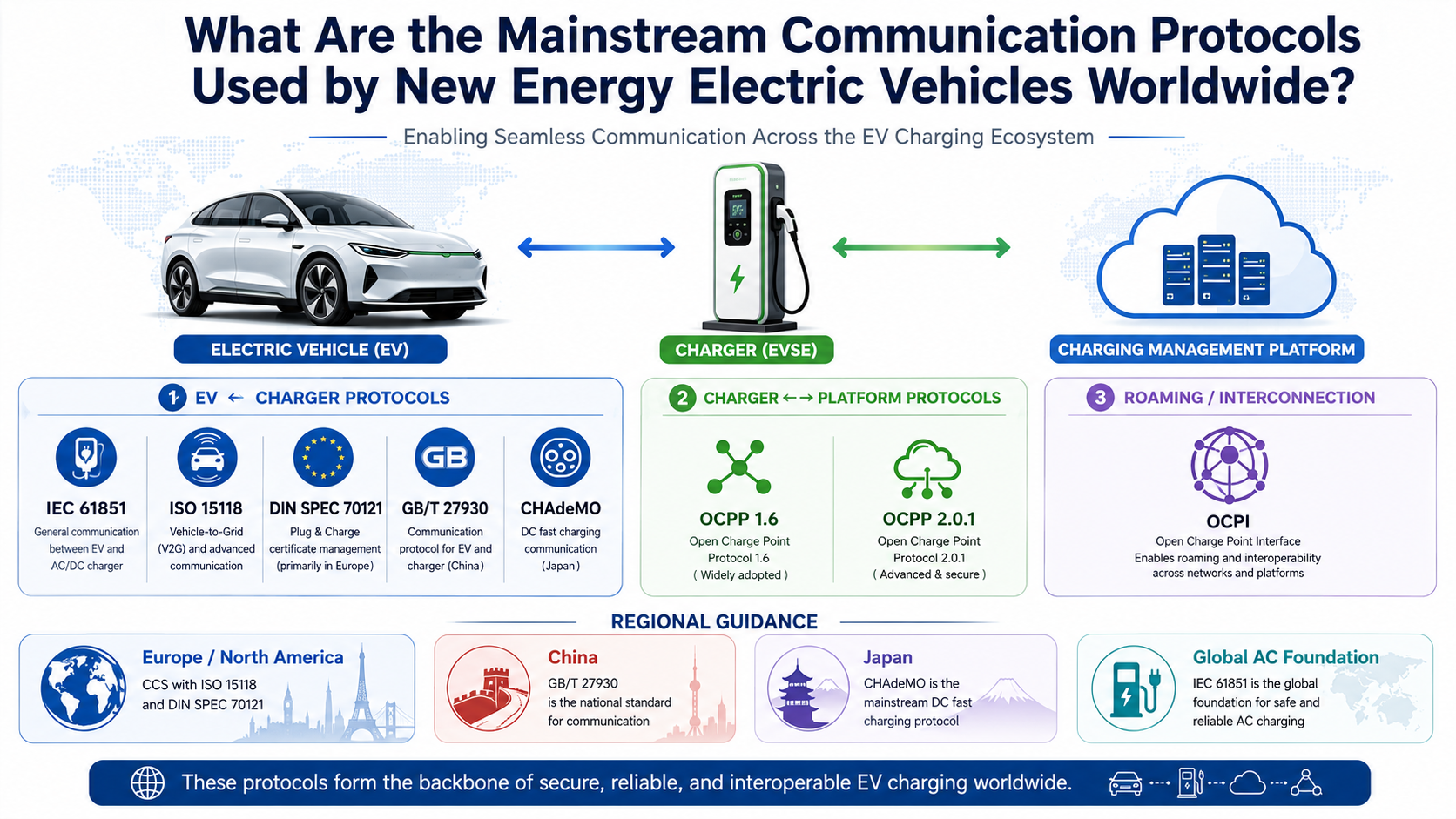
Protocols such as CHAdeMO and CCS play a vital role in fast charging.
ISO 15118 supports bidirectional charging and vehicle-to-grid, or V2G, integration.
Ethernet is a one-stop solution for high-bandwidth data communication, such as video streaming, infotainment systems, and ADAS in electric vehicles.
Wi-Fi and Bluetooth support the integration of smartphones or other devices with electric vehicles.
Below, let us take a closer look at these communication standards.
1. Controller Area Network, CAN
CAN is the primary communication protocol used by most vehicles. Almost all North American and European automakers, accounting for around 70% of the global market, rely on CAN bus technology for engine management, safety systems, and comfort functions. Nearly all luxury and premium vehicles have fully integrated CAN systems, while only a small number of economy models still rely on LIN or multiplexing.
CAN is the communication backbone of all modern vehicles. It allows various electronic control units, or ECUs, such as the engine control unit, airbag control unit, and ABS control unit, to “talk” to each other in real time. These units share critical information to keep the vehicle running smoothly and safely. CAN is also used in other industries, including aviation, aerospace, medical equipment, and industrial automation, mainly because it is cost-effective, reliable, and scalable.
The CAN bus uses only two wires and exchanges data in small priority-based messages, ensuring that critical information, such as braking or airbag signals, is not delayed. CAN relies on Carrier Sense Multiple Access with Collision Detection, or CSMA/CD, allowing devices to take turns transmitting, detecting, and resolving conflicts to ensure message delivery. The protocol includes built-in mechanisms to ensure data integrity and message reliability.
As in traditional fuel-powered vehicles, CAN in electric vehicles enables communication between ECUs, including the electric vehicle control unit, or EVCU, motor controller, battery management system, or BMS, and other key components. These systems continuously exchange data such as battery voltage, current, temperature, motor speed, and torque demand.
For example, CAN provides an important link between the BMS and other systems in an electric vehicle. The BMS monitors battery health, temperature, and remaining charge, and transmits this information to the EVCU and the driver through the CAN bus. The bus also enables communication between the battery pack, cooling system, and EVCU, helping to manage battery temperature.
CAN further enables safety functions such as regenerative braking, traction control, and electronic stability control to operate effectively. The bus allows real-time communication between the braking system and the motor controller to apply regenerative braking.
CAN is also critical for communication between electric vehicles and charging stations. It is used by other standards, such as IEC 61851, for power transfer control, handshaking, and safety checks during charging. Emerging smart grid technologies such as V2G also use the bus for communication between electric vehicles and the power grid. With CAN, electric vehicles can optimize energy use and intelligently adjust charging and discharging according to grid demand.
2. ISO 15118
ISO 15118 is an international standard designed to address communication between electric vehicles and charging infrastructure, enabling bidirectional power transfer and smart charging functions. Its purpose is to improve safety, speed up the charging process, and encourage the integration of electric vehicles into the power grid.
By establishing a standardized interface, ISO 15118 also enhances interoperability between vehicle manufacturers and charging stations. The standard includes two main components: the Electric Vehicle Communication Controller, or EVCC, and the Supply Equipment Communication Controller, or SECC. The EVCC is the controller inside the vehicle that handles communication with the charging station. The SECC is the controller inside the charging station that communicates with the EV.
Using this standard, electric vehicles can receive power from the grid and send power back to the grid, enabling V2G functionality and supporting grid stability and energy management. ISO 15118 also helps adjust charging based on grid conditions, user preferences, and energy prices, optimizing energy use and cost. In addition, the protocol supports automatic authentication and payment using digital certificates, eliminating the need for RFID cards or manual interaction. It uses TLS and digital signatures to ensure data privacy and integrity, preventing unauthorized access or tampering.
Currently, ISO 15118 is still evolving, with new functions and enhancements being added continuously. As a result, its use in EV production remains limited. However, the standard is expected to become the de facto standard for EV charging and grid integration. In the future, it may incorporate wireless charging and advanced energy management functions.
3. CHAdeMO
CHAdeMO, short for “CHArge de MOve,” is a fast-charging standard for electric vehicles developed in Japan. It supports both AC and DC charging, enabling fast vehicle charging. Compared with AC charging, which is widely used at public charging stations and homes, CHAdeMO uses a unique DC approach that can charge batteries very quickly.
Although many charging stations operate at around 50 kW, CHAdeMO can deliver up to 500 kW of power. This means an electric vehicle battery can be charged to 80% in as little as 30 minutes, compared with the typical 4 to 8 hours required by AC charging. CHAdeMO is a fast-charging standard that includes V2G, or vehicle-to-grid, functionality.
CHAdeMO has been widely adopted in Japan, China, and South Korea. However, it faces competition from the mature CCS standard in Europe and North America. CHAdeMO is unlikely to see large-scale adoption in North America. In Europe, the standard has been promoted through partners and pilot projects, but CCS remains dominant.
4. Combined Charging System, CCS
CCS is a standardized fast-charging protocol that is popular in North America and Europe. It uses a unique dual-port connector to accommodate both AC and DC charging plugs. EVs equipped with CCS can access any compatible charging station, regardless of its power capability. CCS supports power levels from 20 kW to more than 350 kW, depending on the specific implementation. Higher power levels help shorten charging time and support the development of ultra-fast charging infrastructure.
CCS relies on standardized communication protocols between the electric vehicle and the charging station. These protocols include:
ISO 15118 — used for V2G communication.
IEC 61851 — used for charging station communication.
Open Charge Point Protocol, or OCPP — used to manage communication between charging stations and central management systems.
TCP/IP — used for internet communication and data exchange between electric vehicles and charging stations during authentication, billing, and monitoring.
WebSocket — used for full-duplex communication between electric vehicles and charging stations.
Existing AC charging infrastructure can be used together with the CCS standard due to its backward compatibility. This means Type 2 AC charging stations remain compatible with vehicles equipped with CCS. Backward compatibility simplifies the transition to CCS and allows the gradual integration of high-power DC fast-charging infrastructure.
5. Modbus
Although Modbus is an industrial communication protocol, its applications have expanded into electric vehicles. The CAN bus is used for data communication between vehicle components, while Modbus is used for communication between specific modules, such as auxiliary power units, cooling systems, or battery heaters.
Modbus provides a simple and cost-effective solution for integrating older components with new systems. The protocol offers an easy way to access and analyze data for performance evaluation and troubleshooting. Automotive engineers widely use it to connect test equipment or diagnostic tools to specific components in EV prototypes. Many EV aftermarket modifications or add-on components, such as custom charging systems, battery monitors, or performance diagnostic tools, also use Modbus to communicate with the vehicle’s existing systems.
One advantage of Modbus is that it can provide reliable long-distance communication. Electric tractors, construction equipment, or heavy-duty trucks can rely on Modbus to communicate with external devices such as diagnostic tools, charging management systems, or specialized accessories. Overall, compared with the CAN bus, the role of Modbus in electric vehicles is relatively limited. Modbus is mainly used for older components, specialized applications, R&D, and aftermarket modifications. The CAN bus remains the dominant standard for most internal communication and functions within electric vehicles.
6. Local Interconnect Network, LIN
LIN is a simple serial communication protocol used for low-cost data exchange between low-power microcontrollers in vehicles. Although CAN remains the main communication standard in electric vehicles, LIN plays a supporting role, meeting the needs of basic functions and legacy systems.
In traditional vehicles, LIN controls door locks, windows, mirrors, seats, and interior lighting, and sends commands to heating, ventilation, and air conditioning systems. Instrument panels use LIN to transmit information related to fuel level, speed, warning lights, and basic sensor data such as coolant temperature or tire pressure. In electric vehicles, LIN has a limited role.
Older EV models use LIN for communication between subsystems such as seat controls, window units, and interior lighting. Since the protocol is only suitable for low-speed applications, it is used by non-critical EV systems such as auxiliary power units, battery heaters, or charging port communication. LIN is well suited for tasks that do not require real-time communication. Some aftermarket EV add-ons or modifications, such as custom lighting systems, battery monitors, or performance diagnostic tools, also rely on LIN.
7. Ethernet
Ethernet is an important technology in computer networking and is increasingly being used in electric vehicles. Ethernet provides higher bandwidth than any automotive protocol, including CAN. It is highly capable of processing large amounts of data quickly, making its high-speed and high-bandwidth capabilities ideal for electric vehicles.
ADAS uses Ethernet to analyze more data in real time, enabling more accurate environmental mapping and smoother vehicle operation. Ethernet facilitates data exchange between cameras, radar, and other sensors, allowing immediate responses for collision avoidance, lane departure warning, and adaptive cruise control. It also supports data exchange between the BMS, electric motor, and other components, enabling real-time analysis of battery health and performance. This helps maximize efficiency and minimize charging time.
Ethernet is also suitable for V2X, or vehicle-to-everything, communication. It supports vehicle-to-vehicle and vehicle-to-infrastructure communication, allowing electric vehicles to share information about traffic conditions, charging stations, and road hazards, thereby optimizing traffic flow and reducing accidents. The standard is used as a physical-layer protocol for V2G communication and bidirectional charging.
Ethernet supports over-the-air, or OTA, updates for various EV systems. It is also used for vehicle-to-cloud communication to enable remote diagnostics, traffic updates, and emergency response. This allows real-time evaluation of EV performance and early detection of potential issues.
As in traditional vehicles, Ethernet in electric vehicles is used by infotainment systems for high-resolution video streaming, faster internet connectivity, and wireless updates. All high-speed data exchange between the BMS, electric motor, and other components in electric and hybrid vehicles can be managed by Ethernet.
8. Bluetooth and Wi-Fi
Bluetooth and Wi-Fi are wireless protocols that enable communication between electric vehicles and external devices such as smartphones. Bluetooth is used for keyless vehicle entry and start, as well as remote locking and unlocking. Many OBD-II scanners connect via Bluetooth, allowing users to access basic engine and battery health information through a phone or tablet.
Bluetooth also connects smartphones to vehicles for safe and convenient hands-free calls while driving. It allows music, podcasts, and audiobooks to be streamed from a phone to the vehicle’s audio system.
Wi-Fi is often used to download and install software updates, or OTA updates, for electric vehicles, ensuring that the latest features and bug fixes are available without visiting a dealer. With in-vehicle Wi-Fi, passengers can access the internet, watch movies, and stay connected while driving. Future electric vehicles may also exchange data with other vehicles and infrastructure to improve traffic flow, safety functions, and grid integration.
9. Summary
The successful integration of electric vehicles into the automotive industry depends heavily on efficient and standardized communication protocols. From the Controller Area Network, or CAN, to the innovative bidirectional communication of ISO 15118, as well as the high-power charging capabilities of CHAdeMO and CCS, these protocols together support the seamless operation and evolution of electric vehicles.
As technology continues to advance, the role of communication protocols in electric vehicles will undoubtedly expand, further enhancing performance, interoperability, and the overall driving experience.