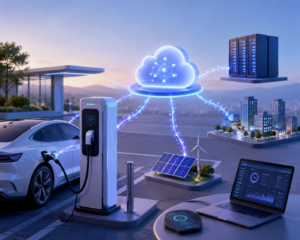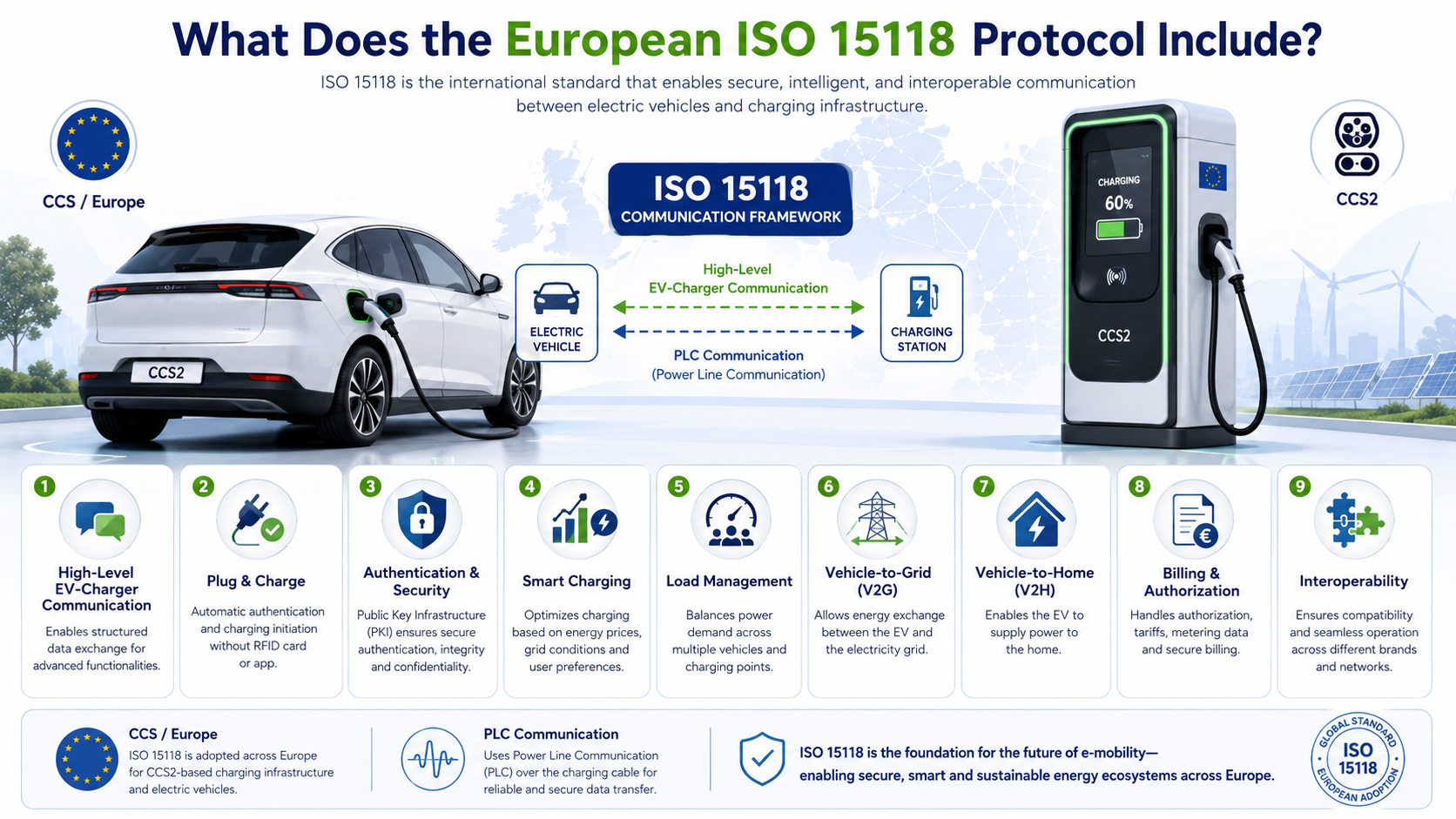
The European standard ISO 15118 is a digital communication protocol between electric vehicles (EVs) and electric vehicle supply equipment (EVSE). It is designed to enable smart charging, Plug & Charge, and vehicle-to-grid (V2G) functions. The following is an overview of its core content.
1. Protocol Scope and Objectives
Core Functions
ISO 15118 enables secure identity authentication between the vehicle and the charging station through digital certificates.
It supports Plug & Charge, allowing users to start charging without manual payment or card operation.
The protocol also supports smart charging scheduling, based on factors such as electricity pricing, grid load, and charging demand.
In addition, ISO 15118 supports vehicle-to-grid (V2G) bidirectional energy transfer, allowing electric vehicles to interact with the power grid.
Application Scenarios
ISO 15118 can be applied to both AC charging and DC fast charging.
It is suitable for public charging stations, private charging stations, and home energy management systems.
2. Core Components
Communication Architecture
At the physical layer, ISO 15118 is based on Ethernet communication, such as IEEE 802.3, or power line communication through HomePlug GreenPHY PLC.
The protocol stack mainly includes:
Application Layer
Defines advanced functions such as charging control, energy transfer, and payment.
Security Layer
Uses TLS 1.2 or TLS 1.3 encryption to ensure secure communication.
Transport Layer
Uses TCP/IP for data transmission.
3. Key Communication Processes
Session Establishment
After the vehicle is connected to the charging connector, the charging station detects the connection through the CP signal.
The vehicle and charging station then exchange digital certificates based on a PKI system to complete identity authentication.
Charging Scheduling
The vehicle sends charging requirements, such as target SOC and charging time window.
The charging station responds with available power, pricing information, and dynamic charging conditions.
Payment and Settlement
Payment can be completed automatically through digital certificates, such as a linked credit card or energy account.
4. Security Mechanisms
Digital Certificates
The vehicle, charging station, and charging operator all need compliant digital certificates issued by a root CA authority.
Certificate chain verification helps prevent man-in-the-middle attacks.
Encrypted Communication
All data is transmitted through TLS encryption to ensure communication security.
Replay Attack Prevention
The protocol uses timestamps and random numbers, also known as nonces, to prevent replay attacks.
5. Main Version Differences
| Item | ISO 15118-2 | ISO 15118-20 |
|---|---|---|
| Communication Method | PLC / Ethernet | Adds support for Wi-Fi and 5G |
| Charging Control | Unidirectional charging | Supports V2G and V2H bidirectional charging |
| Payment Extension | Basic Plug & Charge | Supports time-of-use pricing and micropayments |
| Compatibility | Requires CCS protocol support | Compatible with CCS, CHAdeMO, and GB/T applications |
6. Practical Application Cases
Plug & Charge Services
Plug & Charge has already been deployed in charging networks such as Tesla Supercharger in Europe, IONITY, and Shell Recharge.
V2G Projects
In the Netherlands, V2G projects use ISO 15118-20 to enable electric vehicles to send power back to the grid.
In Germany, Elli uses electric vehicles to help balance peak and off-peak grid loads.
7. Challenges and Future Development
Implementation Challenges
Certificate management is complex, especially because it requires mutual recognition across different charging operators.
Compatibility with older vehicles and older charging stations can also be difficult.
Future Development
Future development directions may include integration with blockchain for decentralized identity authentication and the use of artificial intelligence to optimize charging strategies.
Note
ISO 15118 is an important part of the Combined Charging System (CCS) standard. It plays a key role in European and international EV charging communication, especially for Plug & Charge, smart charging, and future V2G applications.