OCPP 1.6 and OCPP 2.0.1
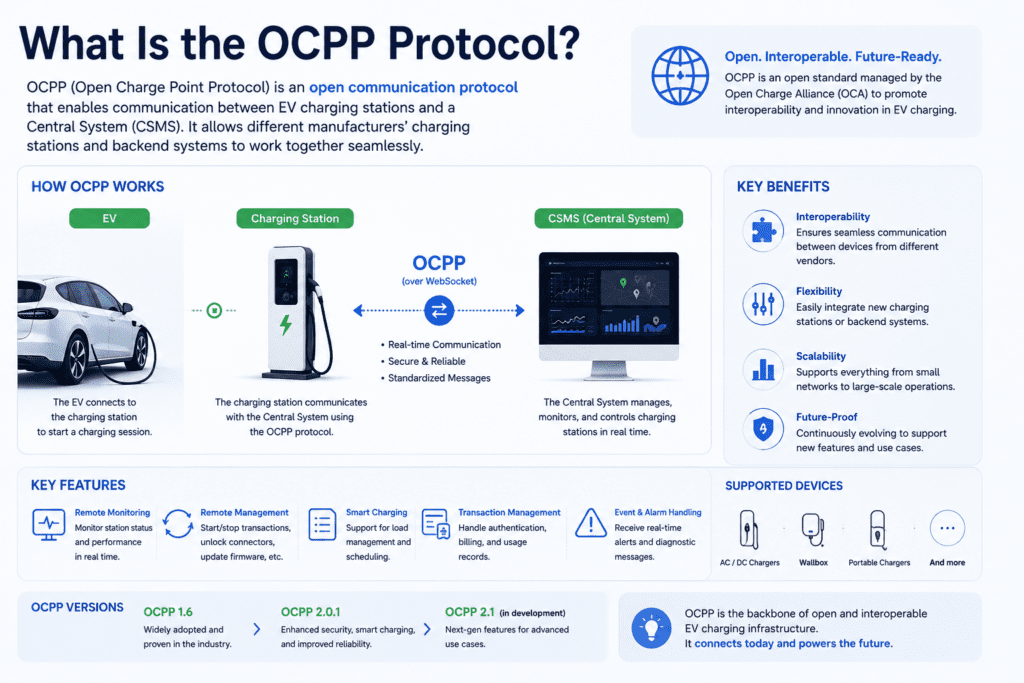
OCPP, short for Open Charge Point Protocol, is an open standard communication protocol used between electric vehicle charging equipment, or EVSE, and a central management system.
The protocol was developed by the Dutch charging equipment operating system developer alliance, known as the OCPP Forum, in 2009. It has gradually become a widely used industry standard for commercial communication in EVSE applications around the world.
OCPP 1.6
OCPP 1.6 is an important version of the OCPP protocol.
It provides the basic functions required for communication control and monitoring of charging stations.
OCPP 1.6 supports electric vehicle charging, charging process control, and charging safety protection.
It also supports real-time data transmission and feedback, such as charging energy, charging power, and other charging information.
OCPP 2.0.1
OCPP 2.0.1, or Open Charge Point Protocol 2.0.1, is an open communication protocol used between electric vehicle charging stations and central systems.
It was released by the Open Charge Alliance and is one of the latest protocol versions currently used in the EV charging industry.
Compared with earlier versions such as OCPP 1.6, OCPP 2.0.1 has major improvements in several areas.
Main Improvements of OCPP 2.0.1
Improved Security
OCPP 2.0.1 improves communication security by introducing HTTPS connections based on secure socket layer technology and a new certificate management mechanism.
This helps ensure secure communication between the charging station and the central system.
More Functions
OCPP 2.0.1 adds many new functions, including smart charging management, more detailed fault reporting, and fault analysis.
More Flexible Design
The design of OCPP 2.0.1 is more flexible, allowing it to meet more complex and diverse application requirements.
Simplified Code
OCPP 2.0.1 simplifies the code structure, making software implementation easier.
Practical Applications
In real-world applications, OCPP 2.0.1 can be used to enable remote control of charging stations, real-time monitoring of charging status, user authentication, and other functions.
This greatly improves the operating efficiency and safety of charging equipment.
The above content is from Share Charging.