I. Introduction
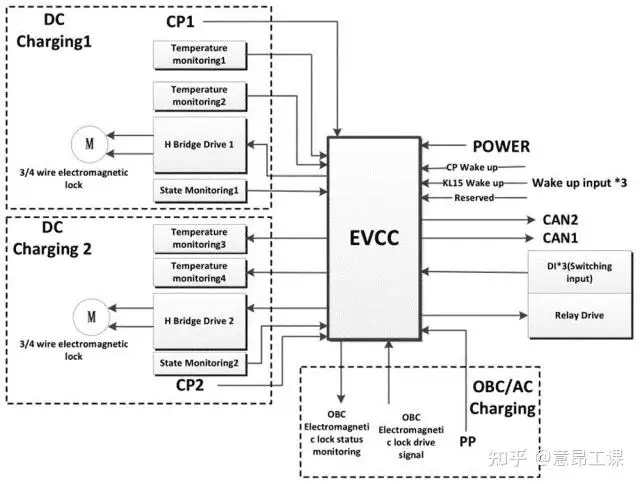
With the growing popularity of electric vehicles, or EVs, the Electric Vehicle Charging Controller, or EVCC, serves as a key bridge between electric vehicles and charging stations and plays a vital role in the charging system. The EVCC is not only responsible for managing the charging process of electric vehicles, but also provides multiple protection measures to ensure the safety and efficiency of charging. This article explains in detail the working principle of the EVCC and its control strategies.
II. Working Principle of the EVCC
Share Charging’s EVCC is a core component of the electric vehicle charging system. It is mainly responsible for the following functions:
Power Conversion and Control
Share Charging’s EVCC includes a power conversion module and a control module. The power conversion module is responsible for converting external AC power into DC power to meet the charging requirements of electric vehicle batteries. This module usually includes a transformer that can adjust the voltage and current of the input AC power, ensuring stable and efficient power supply to the electric vehicle.
The control module monitors the charging process, including recording energy information during charging, adjusting charging power, and controlling the safety of the charging process.
Communication Interface
Share Charging’s EVCC communicates with the electric vehicle, charging station, and power grid through its communication module, enabling information exchange and control. This communication function not only helps identify the real-time charging demand of the electric vehicle, but also ensures precise control of various charging parameters during the charging process.
Safety Protection
Share Charging’s EVCC has multiple built-in protection mechanisms, such as overcurrent protection, overvoltage protection, and temperature protection, to ensure charging safety. Once an abnormal condition is detected, the EVCC immediately takes corresponding measures to prevent damage to the electric vehicle or charging facility.
Charging Metering and Billing
Share Charging’s EVCC can record the amount of electricity used during the charging process and provide related billing information accordingly. This offers convenient charging management and statistical services for both users and operators.
III. Detailed Control Strategies of the EVCC
The control strategy of Share Charging’s EVCC is designed to achieve an efficient, safe, and intelligent charging process. Its main control strategies include:
Handshake Stage
After the electric vehicle is connected to the charging station, the EVCC and the charging station perform a handshake to establish a communication link. This stage is used to confirm the identity and status of both parties and prepare for the subsequent charging process.
Charging Parameter Negotiation
Share Charging’s EVCC negotiates charging parameters with the electric vehicle and the charging station, such as charging power and charging mode. This step ensures that the charging process can be carried out according to the requirements of the electric vehicle and the characteristics of the charging station.
Charging Stage
During the charging process, the EVCC dynamically adjusts the output current and voltage of the charging station according to the needs of the electric vehicle and the characteristics of the charging station. This stage usually adopts a charging method of constant current followed by constant voltage to improve charging efficiency and safety.
At the initial stage of charging, a small current is used for pre-charging to heat and stabilize the characteristics of the battery cells. The process then enters a high-current constant-current charging stage to achieve fast charging. When the battery voltage approaches the set threshold, the process switches to the constant-voltage charging stage, continuing to charge with a smaller current to prevent battery overcharging.
Charging Termination
After the preset charging target is reached, the EVCC sends a signal to notify the charging station to stop charging. At this time, the EVCC also records the energy consumption and related information during the charging process, providing a basis for subsequent billing and management.
Software Updates and Remote Control
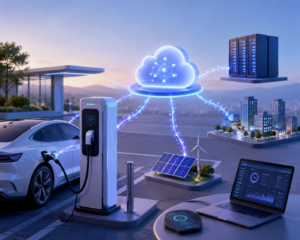
Share Charging’s EVCC supports software update functions, allowing software to be updated remotely to add new features and improve performance. In addition, Share Charging’s EVCC also has intelligent and automated functions. It can automatically identify the electric vehicle model, automatically select the optimal charging strategy, and support remote monitoring and control through cloud services.
IV. International Applications
Share Charging’s EVCC also supports international applications. It can convert China’s GB/T 27930 CAN communication into PLC communication standards such as ISO/IEC 15118, DIN 70121, and SAE 2847-2, enabling GB/T-standard new energy vehicles to charge in overseas markets such as Europe and North America.
At the same time, the EVCC can also convert GB/T 27930 communication into the Japanese CHAdeMO communication standard, allowing GB/T-standard electric vehicles exported to Japan to use local Japanese-standard charging stations.
V. Conclusion
As the core controller of the electric vehicle charging system, Share Charging’s EVCC plays an important role in power conversion and control, communication interfaces, safety protection, charging metering, and billing.
Through refined control strategies and advanced communication technologies, Share Charging’s EVCC enables an efficient, safe, and intelligent charging process, providing strong support for the popularization and promotion of electric vehicles.
With the rapid development of the electric vehicle market and continuous technological progress, Share Charging’s EVCC will continue to evolve and innovate, bringing EV users a more convenient and safer charging experience.